AI content
After two AI Christmases, Coca-Cola chose real people
By DongHyun Kim, Co-founder, CTO and COO · Last updated
On 19 November, Coca-Cola launched this year's Christmas ads in America. They show family and friends playing football, frying a turkey and sitting down to a meal. A film director and a production company made them, and they move away from the generative AI that Coca-Cola used for its last two Christmas ads.
The trade press reports that those AI ads did well by Coca-Cola's own measures, and still divided the people who saw them. If you are about to make your own videos and posts for Christmas, 12.12 or Chinese New Year with AI, it is worth knowing how both can be true before you start.
Should our festive videos be made with AI?
Yes, for the parts that decorate: your product in a festive setting, the lights and backgrounds, the same post in every size and language, and plain notices such as your holiday opening hours. Film the parts the season is really about: your own team, your shop as it really looks, and real customers who have agreed to appear. Check every local detail before a post goes out, and say plainly which parts AI made.
What happened to Coca-Cola's AI Christmas ads
In 2024, and again in 2025, Coca-Cola remade its famous Christmas ad from 1995, the red trucks driving through the snow, with AI. It called the 2024 one "the world's first entirely GenAI-created film on broadcast media". The 2025 version brought the trucks back, with owls and other animals.
System1, a company that tests ads on panels of ordinary viewers, tested the 2025 AI ad. Most viewers liked it: it came top of System1's chart of that year's British Christmas ads. But viewers from Gen Z, today's teenagers and young adults, scored it less than half as highly as viewers overall. And among the viewers who said something negative about the ad, the complaint that stood out was that it was made with AI, with some saying brands should invest in "actual artists".
Marketing Dive reported that the AI ads proved divisive with consumers, "despite exceeding internal benchmarks". This year, Coca-Cola's American films went back to real people. It has not given up on AI altogether: Adweek notes that the brand isn't dropping AI from all of its holiday work.
Why the people in a festive ad should be real
Most ads ask you to want something. A festive ad asks you to feel something: the family at the table, the friends who came home, the people you are buying presents for. System1's research on young viewers found that ads featuring AI moved people less. In Coca-Cola's 2025 AI ad, the onlookers watching the trucks go by were animals rather than people, and System1 thought that change worked, because it gave viewers something new to enjoy beside the familiar parts.
In our view, the risk is greatest for the people in a video. An AI-made person does little harm in a video that explains how a product works. In a video about family and friends, a viewer who starts wondering whether the people are real is no longer feeling what the video was made for.
A Singapore creative leader put the same idea in one line this year. Talking about AI in this year's National Day campaigns, Stanley Yap, head of creative at Splash Productions, told Marketing-Interactive that what matters is "whether Singaporeans can see themselves in it."
Coca-Cola also had something most businesses do not. Its trucks have been on Christmas screens since 1995, and System1's own reading of the 2025 test was that long-familiar pictures like those matter more than the technology. A small business has its own version of those trucks: the owner at the counter, the staff who remember a regular's order, the shop front people walk past every day. That is the part customers already know and trust, so that is the part to keep real.
Think of decorating your shop for Christmas. You can buy the tree, the lights and the ribbon, and no customer minds where they came from. The welcome at the door has to be you.
What AI can make well for your festive posts
These are the parts of a festive campaign where nobody is asked to believe that a person or a moment is real.
- Your product in a festive scene. Your cake on a table set for Christmas, your gift box beside a tree. Build it from your real photo and check it against the product itself: our guide to making product photos with ChatGPT shows how.
- The decorations. Backgrounds, lights, a reunion dinner table behind your product, the frame around a sale price.
- Every size and every language. The same post tall for Reels and TikTok, square for the feed, wide for your website, in English and in Mandarin.
- Ideas before you film. Five ways to open your Christmas video, tried in an afternoon, so the filming itself can be short.
- The notices. Your holiday opening hours, the last day to order for delivery before Christmas, the dates of your 12.12 sale.
What to film for real
These are the parts where the person or the place is the point.
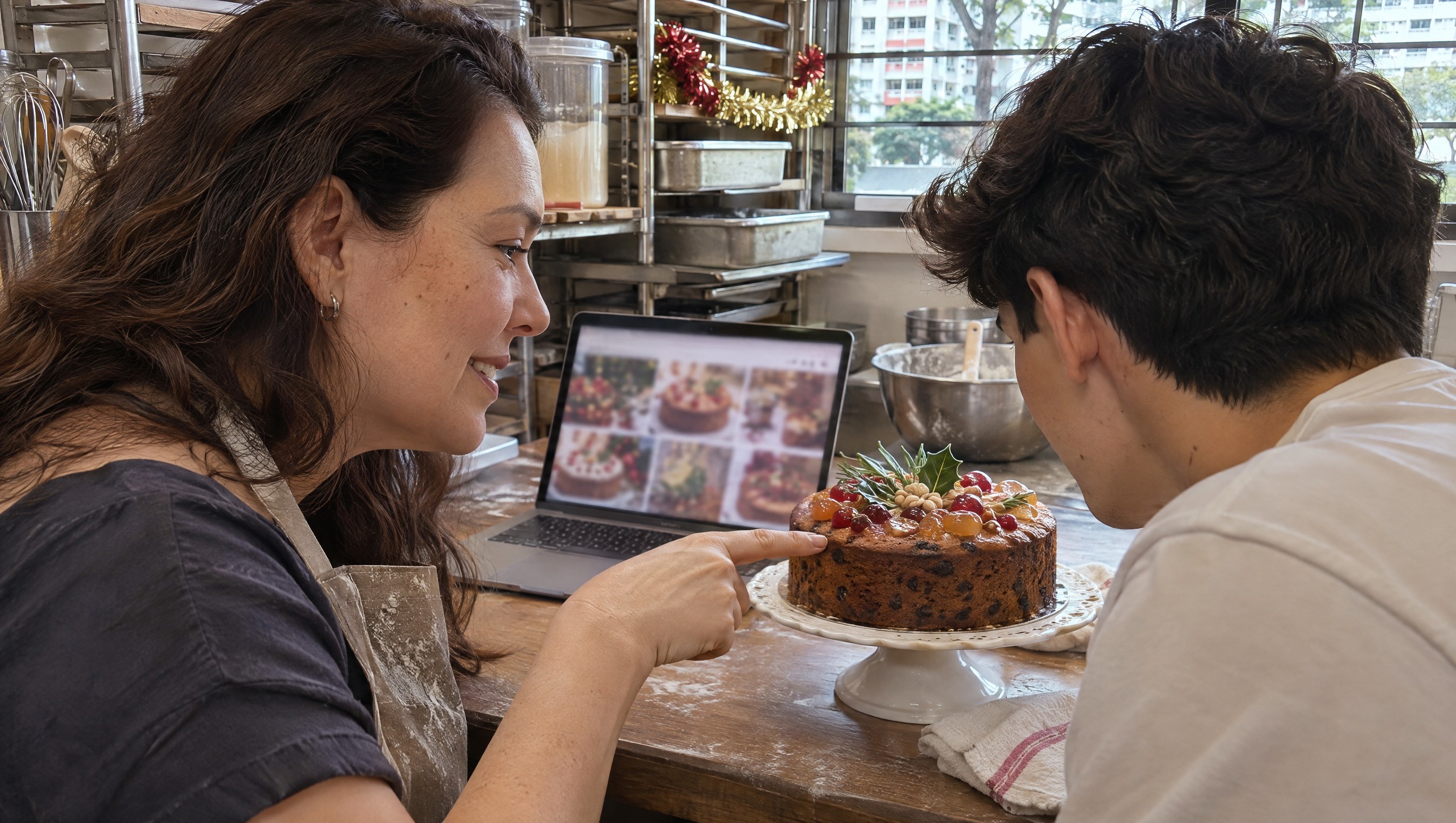
- Your people. Your team packing the hampers, you thanking customers at the counter. You can film this in a few minutes on a phone, in your own shop.
- Your real customers, only with their permission. A customer's own words about your log cake should come from that customer. An AI person should never speak as one, and our article on AI presenters explains why.
- Your shop as it really looks. If a customer walks in after seeing your video, the shop should look like the video.
- Anything with a local symbol in it. In July, residents in Bedok North spotted that an AI-made National Day banner showed a flag with no stars and no crescent, and another banner nearby showed a made-up building labelled "Singapore National Indoor Stadium". The banners were taken down, and the community club said that AI output "should always be carefully checked before it is used". Your customers know the details of their own festivals, from the greeting on a Chinese New Year card to the food on a Christmas table, so a wrong one is easy for them to spot.
Say which parts AI made
People here want to know. In a YouGov and Meltwater study released in April, 84 in every 100 people asked in Singapore said it is important for AI-made content to be clearly labelled.
TikTok, Facebook, Instagram and YouTube each have their own rule for that label, and our article on AI presenters sets out where each one asks for it. Shopee asks for its own label on Shopee Video, as our article on Meta's video tool explains. This month, TikTok also opened a checker where anyone can upload a video to see whether it carries the marks TikTok adds to content made with its own AI tools.
So, as well as any label a platform asks for, say it yourself in plain words. A line in the caption such as "festive scenes made with AI, our team filmed in our shop" tells customers more than a small mark they have to look for.
Where we would start
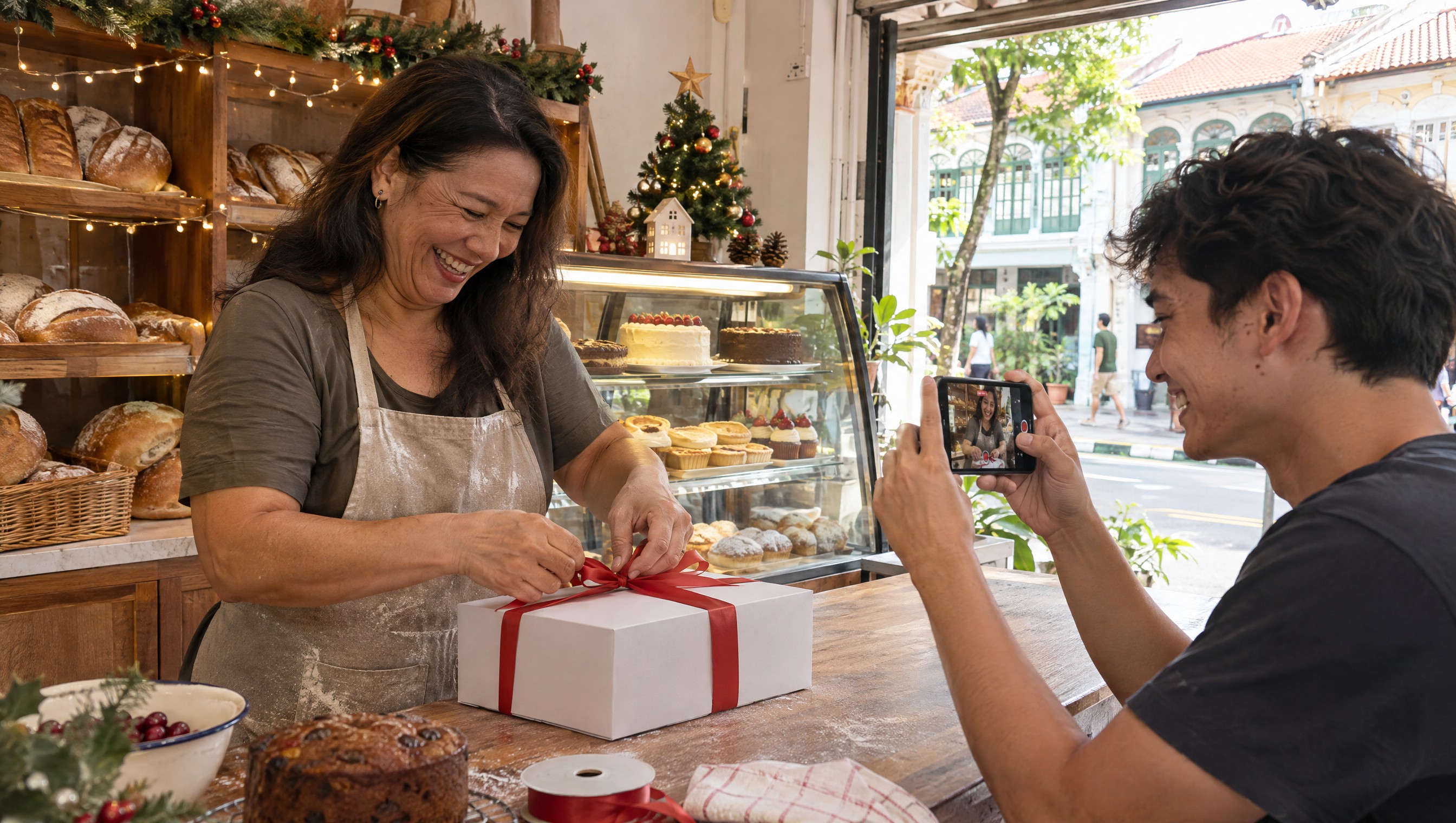
If you are making one festive video this year, this is how we suggest splitting it. Film the people part on your phone: ten or fifteen seconds of you or your team, in your own shop. Let AI make the product shots and the festive setting around them, from your real product photos. Put the two together, and say in the caption which parts AI made.
Then, on the first day it is up, read the comments and the messages as well as the views. Coca-Cola's AI ads did well by its own measures, and last year's scored well in System1's test, yet they still divided people. You will not have a test panel, but you will have comments, and they tell you how people feel. If people ask whether it is real, the caption was not clear enough. If they ask about the cake, the video is doing its job.
Questions owners ask
Does the same go for our Chinese New Year videos?
Yes, and more so. Chinese New Year falls on 6 and 7 February 2027, and its videos are about family, visits and the reunion dinner. Let AI make the gift box on the table and the red and gold around it. Film the people, and have someone who celebrates it check every greeting and every dish before the post goes out.
What if most of our customers are young?
Then the people part matters even more. In System1's test, Gen Z viewers rated Coca-Cola's AI ad less than half as highly as viewers overall. One company's test is not your customers, but if many of yours are in their teens and twenties, it is one more reason to show them real people.
Should we stop using AI because Coca-Cola did?
No. Coca-Cola moved away from AI for its American Christmas films, and Adweek reports that the brand is not dropping AI from all of its holiday work. The question is which parts of a video AI makes, not whether to use it.
Can AI WISE make our festive videos and pictures?
Yes, the parts AI makes well. AI WISE is a Singapore-based digital marketing agency serving Asia, and AI content production is part of our work: video ads, ad images and product photos, your product in festive scenes and in every size. Every one we make with AI starts from your real, unedited product photos. An AI person never speaks as a customer, we add the AI label wherever a platform asks for it, and nothing is delivered until you approve it. Each project is quoted before work starts. See how our AI content production works.