AI content
Should an AI avatar be the face of our videos?
By DongHyun Kim, Co-founder, CTO and COO · Last updated
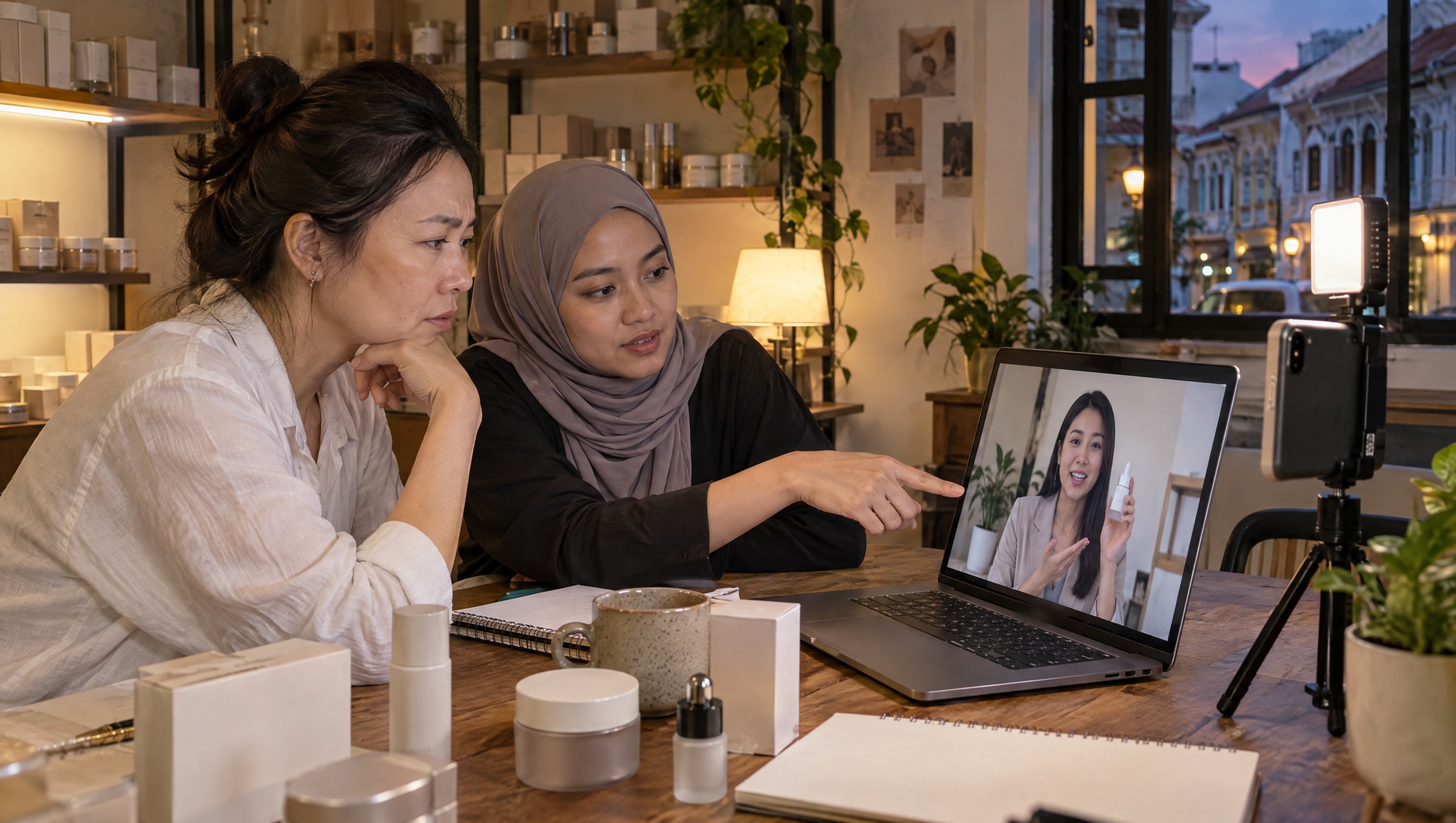
On 20 October, a survey asked about a thousand Americans what they liked least in AI-made ads. The answer was the people.
46% said they dislike seeing AI-made people in ads. No other AI-made picture in the survey was disliked as much. AI-made landscapes were liked most.
In Singapore, AI people are already at work. When CNA looked in August, it found AI hosts running live sales for household brands on Shopee and Lazada. An AI presenter never needs a second take, can say the same lines in Mandarin or Malay, and works for far less than a person.
Should an AI avatar present your business videos?
Yes, for videos that explain or repeat: how your product works, the answers to questions customers ask every week, the same message in Mandarin, Malay or Tamil, a live sale at hours nobody can staff. Use a real person when the video rests on someone's own word: a customer's review, your story as the owner, advice from the person a buyer will deal with. And never let an AI person say they have used your product.
An AI avatar, or AI presenter, is a person on screen made by AI who says the words you type. Some are made-up faces. Others copy a real person from a short recording of their face and voice.
Viewers accept AI scenery sooner than AI people
Nearly half disliking AI-made people sounds like a reason to stay away. Read it beside the rest of the survey, though. The same people were happy with AI-made scenery. What bothers a viewer is a person who might not be what they seem.
Think of a mannequin in a shop window. Nobody minds that it isn't real, because it never pretends to be. A mannequin that told you "I wear this every day" would be another matter.
Singapore's researchers draw the same line. A marketing professor at SMU told CNA that using AI "will not necessarily damage a brand. Using it poorly can." A professor at NUS warned that AI, virtual influencers above all, can feel uncanny to some customers: "It gives them the creeps."
Who uses it matters too. A researcher at NTU said most of the backlash falls on big brands, and on luxury brands most of all, because buyers read an AI ad from a brand that could afford a film crew as a lack of effort. A researcher at NUS added that a small business may be forgiven, because people assume it lacks the budget.
Where an AI presenter does the job well
These are the videos where viewers care about what they learn, not who tells them.
- How your product works. The steps, the parts, what comes in the box. The product on screen must be the one the customer receives, so the video starts from your real photos.
- The questions customers ask every week. "Can it go in the dishwasher?" "Do you deliver to Jurong?" One short video for each, made in an afternoon and changed in minutes when the answer changes.
- The same video in English, Mandarin, Malay and Tamil. A filming day for each language is rarely worth it for a small business. Agoda told CNA that AI took its video versions from 64 to 720 a month, across languages and markets.
- A live sale at hours you can't staff. A Singapore company that rents out AI hosts told CNA that a human host costs S$3,000 to S$4,000 a month for four or five hours a day, and its AI host S$458 a month, around the clock. It said both draw about ten viewers at a time. That is a seller describing its own product, and it added a condition: it works for brands shoppers already know, whose buyers arrive knowing what they want and at what price.
- Quick updates. This week's offer, the new opening hours, a price change. Nobody needs to see you in person to learn that the shop now closes at eight on Sundays.

Where a real person is still the better choice
These are the videos where the person is the proof.
- Anything that rests on experience. "I use it every night." "My son's marks went up." Only a real customer can say that, and only with their permission. One Singapore agency founder told CNA that a tuition centre's testimonial video should show real parents, children and teachers, to show it is "legit".
- Your own story. Why you started, and what you refuse to cut corners on. A buyer deciding whether to trust you wants to see you.
- Advice from the person a buyer will deal with. A contractor, a tutor, a clinic's own staff. The buyer is judging that person as much as the advice.
- A brand that sells on craft and care. The more a buyer pays for the effort behind a product, the more an AI face looks like the effort you skipped.
- Real use, up close. When a buyer has to see a real person wearing, applying or holding the product to judge it, film it.
A made-up face, or a copy of you?
There are two kinds of AI presenter, and they raise different questions.
A made-up face belongs to nobody. It can show your products and answer questions. It can never be your staff or your customer, and it should never be introduced as either.
A copy of a real person is made from a recording of their face and voice. A copy of yourself is the honest middle ground: your face, saying words you wrote and checked, without the filming. YouTube now gives creators an avatar of themselves, made from a short selfie recording. Only the owner can use it, and every video it makes is labelled as AI. It is reaching countries one by one, Australia, Canada, New Zealand and the United States first.
A copy of someone else, such as a member of staff, needs their permission in writing first: what it may say, where it will run, and what happens to it when they leave.
The rules that come with it
- It never speaks as a customer. A label does not fix that. The chairman of the Advertising Standards Authority of Singapore put it plainly this year: "Disclosure of the use of AI alone does not whitewash this issue."
- Label it where the platform asks. On TikTok, an ad whose video is fully made or heavily changed by AI is marked as AI-generated when you create it. YouTube asks creators to disclose a realistic person or scene made by AI, though a copy of your own voice used to dub a video needs no label. Facebook and Instagram show an "AI info" label when they detect AI or when you say so. In the 20 October survey, 44% said finding undisclosed AI in a brand's ads would lower their trust in it.
- Say it plainly, once. The same watchdog has called "indiscriminate and vague" notices of AI use unhelpful. One clear line where viewers will see it, such as "presented by our AI presenter", tells them more than a small mark buried in the caption.
Try one this week
- Pick the question customers ask you most, the one you answer on WhatsApp every few days.
- Write the answer in your own words, about thirty seconds long, and read it aloud once.
- Make two versions. You, on your phone, at the counter. And the same words from an AI presenter.
- Label the AI one where the platform asks, in plain words.
- Post them a week apart, at the same time of day, and compare what matters: messages, saves, and how many people watched to the end.
- Read the comments. If people ask whether the presenter is real, your label isn't clear enough. If they ask about the product, the video is doing its job.
Questions owners ask
Will customers be able to tell the presenter is AI?
Many will, and the label tells the rest, so plan for it rather than hide it. A presenter that is clearly a presenter, saying true and useful things, is judged like any other video: on whether it helped. Trouble starts when it pretends to be someone it isn't.
Is an AI presenter cheaper than filming?
Usually, yes. There is no filming day, and a change is a new line of script rather than a second shoot. The script, your checks and the labels still take time. Our guide to what a video ad costs in Singapore shows how much of a quote the filming day takes.
Can I make an AI avatar of one of my staff?
Only with their written permission, and with clear limits: what it may say, where it runs, and what happens to it when they leave. Many owners start with a made-up face for exactly that reason.
Can AI WISE make videos with an AI presenter?
Yes. AI WISE is a Singapore-based digital marketing agency serving Asia, and our AI content production makes video ads, ad images and product photos from your real, unedited product photos. Our AI presenters talk about what you get, the way a good salesperson would. None of them ever says they have used your product, and each ad carries an AI label wherever a platform asks for one. You approve the script before anything is made, and every project is quoted before work starts. See how our AI content production works.